
Cure4CF Update
The Bionic Pancreas and Beyond: Transforming Diabetes Care in Cystic Fibrosis
As treatments improve and people with cystic fibrosis live longer, complications beyond the lungs are becoming increasingly important. One of the most common is cystic fibrosis-related diabetes—or CFRD.
At the Australian Cystic Fibrosis Conference, Dr Melissa Putman from Boston delivered a fascinating presentation on why CFRD is so complex, why it can be difficult to detect and how new technologies could transform its management.
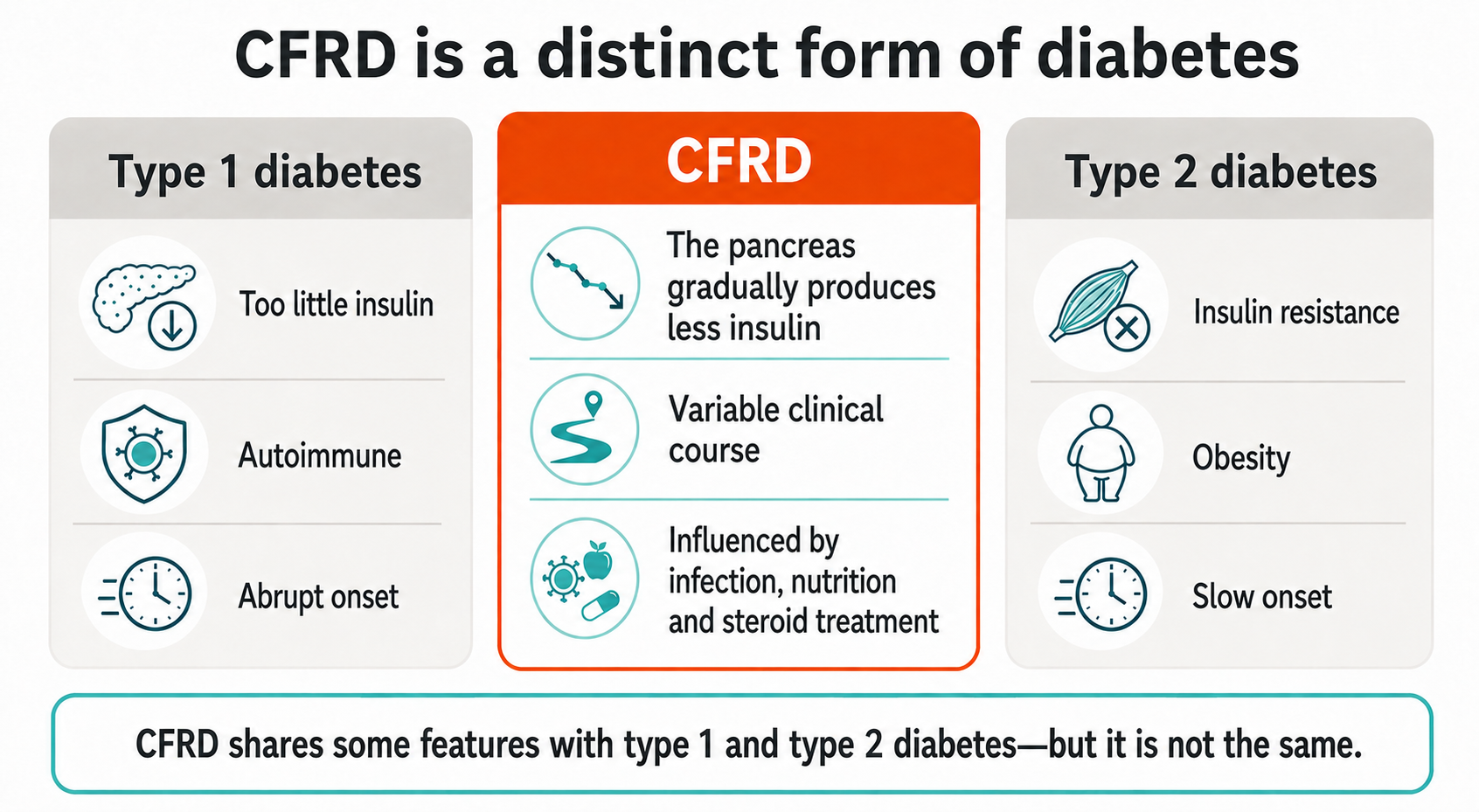
CFRD is a distinct form of diabetes
CFRD shares some features with both type 1 and type 2 diabetes, but it is not quite the same as either. It is a unique form of diabetes caused by a complex combination of factors associated with CF.
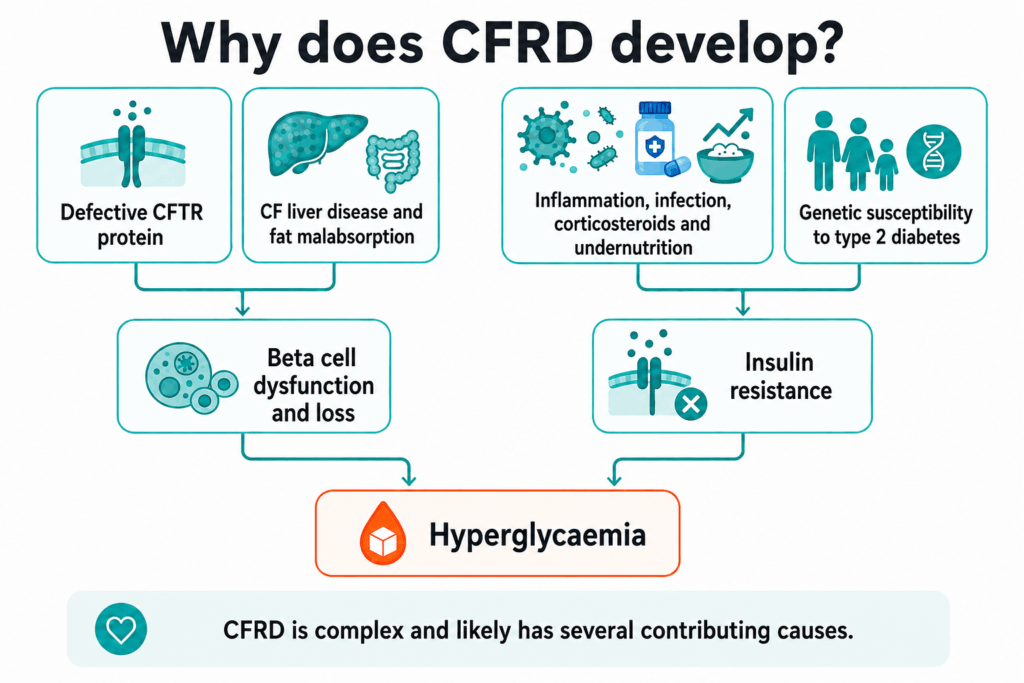
A central problem is the progressive loss of function of the pancreas’s beta cells—the cells responsible for producing insulin. Abnormal CFTR protein may contribute to this process through several different mechanisms, but there is still much we do not understand about exactly why CFRD develops.
Blood glucose patterns in CFRD can also be unusual. Fasting and overnight glucose levels may remain normal, while glucose levels can vary greatly for short periods after meals. These brief spikes and dips can be missed when we look only at average glucose levels or single point of time glucose level.
Glucose control can become even more difficult during infections or when corticosteroids are needed. Some people with CF may also experience episodes of low blood glucose, adding another layer of complexity.
Graphic adapted from Dr Putman’s presentation at ACFC 2026.
Why does CFRD matter?
CFRD is not simply an additional diagnosis for someone already managing CF. It can affect nutrition, weight, lung function and infection risk.
When the body does not produce enough insulin, it becomes harder to use nutrients effectively and maintain muscle and weight. High blood glucose may also increase glucose lining the airway cells, potentially creating conditions that promote infection and inflammation.
This can establish a vicious cycle: infection and inflammation can make glucose more difficult to control, while poor glucose control may further affect lung health.
Recognising CFRD early is critical—not only for managing blood glucose, but also for protecting overall health.
The challenge of screening
The oral glucose tolerance test (OGTT) remains the recommended test for CFRD because fasting glucose can appear normal in its early stages. It involves drinking a glucose solution after fasting, followed by blood tests to measure the body’s response.
However, the test takes time, requires fasting and can be difficult to fit into an already demanding CF treatment schedule. Dr Putman highlighted that only around 40% of adults recorded in the US CF Foundation Patient Registry completed the recommended test in 2024.
There is another important question: much of the evidence supporting current screening approaches was generated before CFTR modulators transformed CF care. We now need to understand whether the patterns, risks and best methods for detecting CFRD are changing in the modulator era.
Graphic adapted from Dr Putman’s presentation at ACFC 2026.
Why HbA1c may not tell the whole story
HbA1c is widely used in other types of diabetes because it provides an estimate of average glucose over the previous two to three months. The difficulty in CF is that an average can look normal even when glucose is rising sharply after meals. HbA1c may therefore miss the early glucose variability that is characteristic of CFRD. High or low HbA1c results can still provide useful information. However, a result in the normal range does not necessarily rule out early glucose abnormalities. Some teams use a HBA1c threshold, like 5.5%, to help identify who would benefit most from an OGTT. This could potentially reduce the number of people needing the full test, but it is an emerging approach and is not currently a replacement for recommended screening.
Could continuous glucose monitoring help?
Continuous glucose monitoring, or CGM, uses a small wearable sensor to measure glucose throughout the day and night. Unlike a single blood test, CGM reveals the pattern across time and can detect short-lived glucose changes, show how much time glucose remains above a particular level and identify periods of low glucose. Studies have also found associations between CGM measures, lung function and nutritional status.
CGM is already proving useful in guiding treatment, but larger and longer studies are needed before it can replace the OGTT for diagnosing CFRD.
Smarter insulin delivery
The most exciting part of Dr Putman’s presentation was the progress being made in automated insulin delivery. Hybrid closed-loop systems connect a CGM with an insulin pump. The system receives glucose readings and automatically adjusts insulin delivery, helping people spend more time within their target glucose range while reducing some of the daily decision-making involved in diabetes care. Early experience with systems such as Omnipod 5 and Control-IQ suggests that automated insulin delivery may improve glucose management for people with CFRD. However, more CFRD-specific research is needed.
The “bionic pancreas”
Dr Putman also presented research into the iLet bionic pancreas—a device not currently available in Australia. Rather than requiring the user to calculate detailed insulin doses, the person enters their body weight and the device gradually learns and adapts to their insulin needs.
In a small randomised study, 20 adults with CFRD used the bionic pancreas for 14 days and received their usual care for another 14 days. With the bionic pancreas, participants spent an average of 75% of their time within the target glucose range, compared with 62% during usual care. Their average glucose was also lower, without an increase in CGM-detected hypoglycaemia.
These are early but extremely encouraging results. A larger multicentre study is now examining the technology further, and the CF community will be watching closely.
Looking ahead
Dr Putman’s presentation showed just how much remains to be learned about CFRD—but also how quickly the field is moving.
CGM, automated insulin delivery and adaptive technologies such as the bionic pancreas offer a glimpse of a future in which CFRD may be detected earlier and managed more precisely, with less burden on people living with CF. This is exactly why investment in CF research remains so important.
An Australian access gap
Despite its potential, access to CGM remains inequitable in Australia. People with CFRD who require insulin may qualify for subsidised CGM through the National Diabetes Services Scheme while under 21 but generally lose eligibility when they turn 21. Adults must then meet the substantial ongoing cost themselves or rely on finger-prick testing.
This is not acceptable. CFRD does not become less complex at 21. The Australian Government must expand subsidised CGM access to all people living with CFRD who would benefit, regardless of age. As research continues to demonstrate the value of this technology, Australians with CF should not be left behind.
This article provides general information and is not a substitute for advice from your CF or diabetes care team.